Last week, we drove out to Gamla Berget, a little crag near Gothenburg, for two days of sport climbing. I haven't sport climbed at all in the last few months (the last time was sometime after Christmas), and I was super excited to get back on the ropes!
It was interesting to notice how quickly I got back into the "mode" of sport climbing. Being more in bouldering shape at the moment, I decided to project something instead of doing onsights. Before heading there, my attention was caught by the two lines Hybrid (7c) and Hydran (8a). They both follow a really nice crack feature that eventually splits up into two different lines. From afar, the cracks combined show a beautiful diamond-like feature; it's a striking piece of rock that is asking to be climbed.
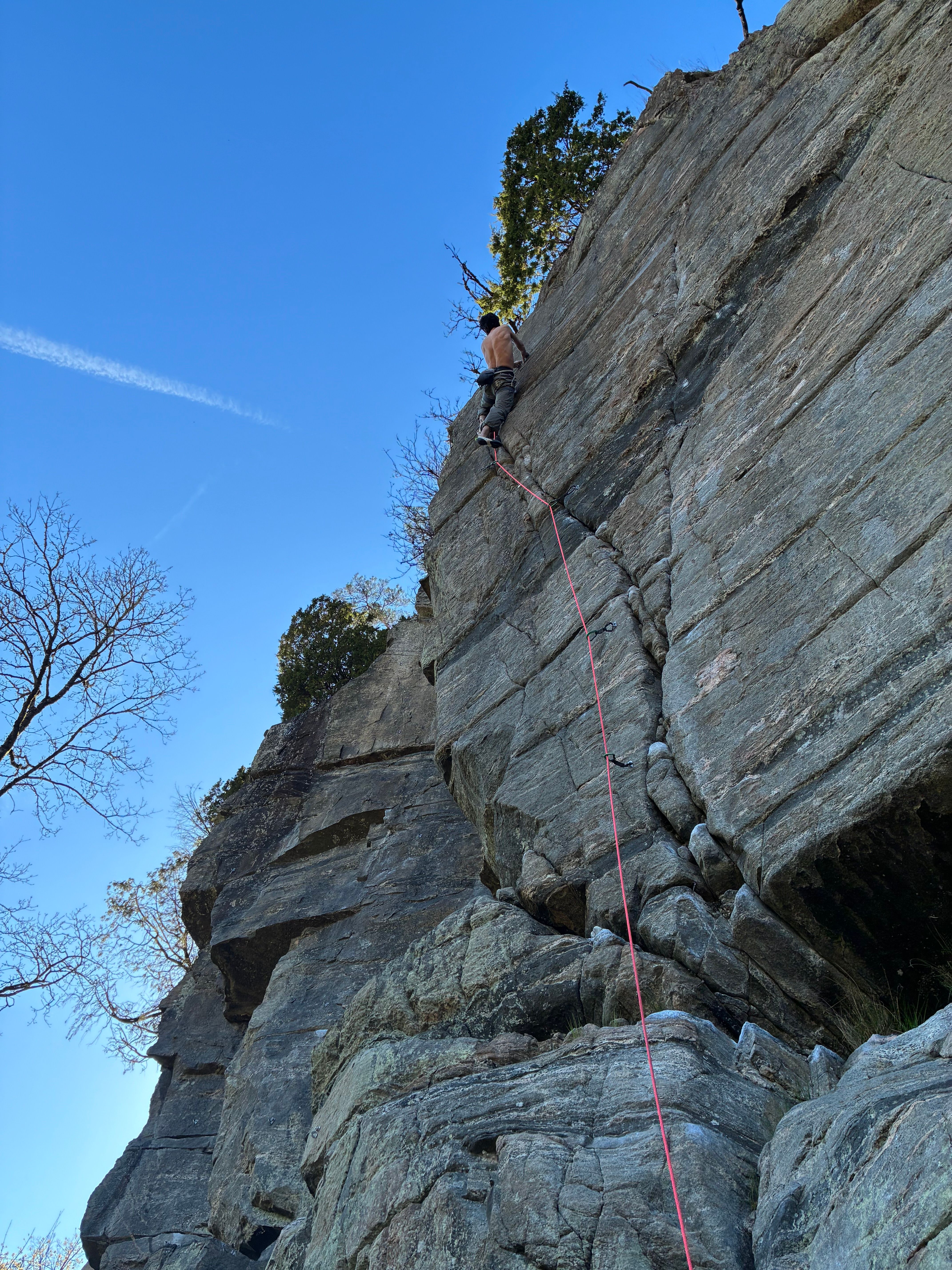
Since I'm still dealing with a small finger injury, I decided to try Hybrid, as it seemed that Hydran had a crux with two very small crimps. I quickly managed to figure out the moves (being in good bouldering shape helped), and was excited to give a red point go. Due to my current injury, I'm only allowing myself to do very little volume of climbing. Therefore, I allowed myself to try once per day (I know, very little, but a necessary evil to allow my finger to recover).
On the first red point attempt, I fell at the crux, which revolves around 5 moves where you have to untangle yourself with two vertical pinches. I fell and was very happy with my attempt. I managed to stay focused, enjoy the flow, and there was very little hesitation in my movements. When I fell, I said out loud, "That was good" and jumped into a learning mindset; "I have to figure out what to do there". I was surprised by this after such a long time of not sport climbing.
The day after, things changed. I knew I only had one attempt and after warming up on a neighbouring route, I felt a lot of pressure. I knew I could do this route. The level was something that I could onsight last year quite easily. I tied in and climbed surprisingly well. I arrived at the rest before the crux and knew I would be able to climb this route. My mind wandered a bit, "It would be so cool if I could tick this route". I tried to ground myself to not get distracted. I felt the texture of the holds and took a deep breath.
I climbed past the crux without any mistakes and arrived at a small jug where you have to clip. I was really pumped at this point and had to shake out before I could clip the quickdraw. I knew it would be hard from here. I got my feet up and just barely managed to grab the crimp. I readjusted a couple of times, tried a full crimp, stopped the full crimp (I don't want to full crimp my injured hand yet) and did a desperate throw to the jug, but missed. I was hanging in the rope, frustratedly hit my legs on the wall, and uttered"stupid!"
The moment pressure takes over your climbing project
There was a sharp contrast between my two approaches to the climb. The day before, I approached the climb and challenge in a positive light. I was on a journey to discover the moves, make links, and get myself acquainted with sport climbing again. Every little win felt great: figuring out the beta for the crux, finding optimisations, feeling comfortable committing above the bolt. But once I got this "solved", the only thing that seemed to matter was "ticking off" the route. The release of frustration is a result of that. I fell off the route getting a high point and doing a fantastic job staying in the moment whilst the climb, but instead of being happy with my progress of getting back into sport climbing, I was frustrated, and I felt "stupid".
Where does our pressure to perform come from?
We have different reasons to put pressure on ourselves. In my case, I believe it comes from a pattern I have taught when I started climbing, or at least from my early years of climbing. Most of my identity I tied to how I performed on the wall. I would get a lot of appraisel whenever I sent a hard route in the climbing gym, or when it would come back from a climbing trip having climbed something difficult. As a result, as soon as I got close to sending something, the thought "oh if I send this I would be so cool" appeared.
This feeling of pressure maxximized when I started to join competitions. I remember the insane nerves while waiting to get to climb. I never climbed like myself, there was too much pressure and need to perform at this one particular moment.
And even though I no longer compete, that same pattern can still show up when I’m projecting a route. Suddenly the send becomes more than just a climb. It becomes proof. Proof that I am improving. Proof that I am strong enough. Proof that I deserve to be climbing coach. Proof that the training worked. Proof that I am the person I want others to see.
That is when pressure grows.
Sometimes pressure also comes from comparison. Seeing others send, hearing grades, watching stronger climbers move with ease. We start to feel behind. We think we should be further along, stronger by now, better than we are. So every attempt starts to feel urgent.

How is pressure to perform hindering your climbing performance
In sports psychology, the concept of "choking under pressure" describes a decline in performance caused by internal or external pressure. It is believed that pressure increases a performer's awareness of their own actions, disrupting the automatic nature of skill execution (Baumeister, 1984). For climbing, a "flow" state is a state where our bodies are moving without thinking. It's just you, the route or boulder, and your body seems to make the moves by itself. In this process, there are a lot of automatic actions performed that our conscious mind does not seem to be a part of.
However, when pressure creeps in, our conscious mind becomes more active — causing us to over-control movements that would otherwise happen automatically, which ultimately hurts performance (Beilock & Carr, 2001). Instead of intuitively grabbing the next hold, you think about how your body position is before grabbing it, or you realise the friction on the hold is less good than expected. What should've been a flow and continuous move is now a process where your conscious brain is a part of.
This shift from automatic to conscious control not only affects us mentally — it has physical consequences too. Anxiety and pressure trigger a measurable stress response in the body: heart rate increases, breathing becomes shallower, and muscle tension rises (Kilic et al., 2020). When we climb, this is particularly problematic. Increased muscle tension in the forearms restricts blood flow, accelerating the onset of pump and causing grip strength to deteriorate faster than it otherwise would.
What can we do about the pressure to perform whilst climbing?
Knowing that pressure is working against you is one thing. Being able to do something about it is another. The good news is that sports psychology has spent decades researching this problem, and several practical strategies have proven effective. None of them is a magic fix, and like anything in climbing, they require practice. But they give you something to work with when you feel the pressure creeping in.
Shift your focus to the process
The most direct antidote to outcome pressure is redirecting your attention toward the process — the small, controllable actions that actually get you up the route. Research shows that setting process-oriented goals increases task-focused attention and reduces the mental noise that comes with thinking about the send (Hill et al., 2009). Instead of "I need to do this today", it becomes "I want to figure out that foot sequence on the third bolt." The route does not change. But what you are paying attention to does.
For me, this is exactly what made the day before feel so different. I was not trying to send. I was trying to figure things out. And that single shift in intention changed everything about how I moved and felt on the wall.
Build a pre-attempt routine
A pre-performance routine is any set of physical or mental steps you consistently go through before an attempt. Research consistently identifies it as one of the most effective tools for preventing choking under pressure (Mesagno & Mullane-Grant, 2010). It could be how you tie in, how you breathe, a cue word you repeat, or the way you visualise the first few moves. The content matters less than the consistency. The routine signals to your nervous system that this is just another attempt — not a life-or-death moment.
Think about how differently you approach a casual attempt versus one where you feel ready to send. The pre-attempt routine is a way of bringing that casual energy into the high-stakes moment.
Use self-talk deliberately
The voice in your head during a redpoint attempt is not neutral. It is either helping you or working against you. Studies have shown that deliberate, positive self-talk reduces the likelihood of choking and helps athletes maintain focus under pressure (Mesagno et al., 2024). That does not mean telling yourself everything is fine when it is not. It means replacing "do not fall here" with focus cues such as "keep your hips thight on that move" — shifting from fear-based to action-based language.
"Stupid." That one word I said after falling was not just frustration. It was my inner voice working against me. Learning to catch that voice and redirect it is a skill, and like all skills, it gets better with deliberate practice.
Train under pressure
One of the reasons competition climbing always felt so different to me was that I had never really trained for the pressure itself — only the physical side of it. Research calls this acclimatisation training: deliberately introducing pressure into your practice sessions so that it feels less foreign when it matters (Oudejans & Pijpers, 2009). This might mean asking someone to film your attempts, setting a limit on how many tries you give yourself, or climbing in front of others more often. The goal is to make pressure a familiar feeling rather than a threatening one.
Mindfulness and breathing
When pressure spikes, the body responds first — heart rate climbs, muscles tighten, breathing becomes shallow. Mindfulness-based practices have been shown to improve attentional control, reduce anxiety, and help athletes stay task-focused under pressure (PMC, 2025). In practical terms, this can be as simple as taking three slow, deliberate breaths before you leave the ground. It will not eliminate the nerves. But it can bring you back into your body and out of your head at exactly the moment you need it most.
This can also be applied whilst you are climbing. When we are under pressure, we tend to hold our breath, or it gets shallow. Deliberatly focusing on breathing out loud and releasing can help to stay focused, grounded and present in the moment.
Integrating the mental aspect into climbing coaching
Working on the mental side of climbing is a big aspect of my climbing coaching. I believe that there is always room to grow when it comes to dealing with pressure, focus, and staying present while projecting, training, or simply getting better. When you receive coaching from me, we will try to address these challenges during our weekly video calls, and we will actively work on them during your training sessions.
If you would like to learn about how I can help you with your climbing and the mental side of it, feel free to book a free 30-minute consultation.
Citations
Baumeister, R.F. (1984). Choking under pressure: Self-consciousness and paradoxical effects of incentives on skillful performance. Journal of Personality and Social Psychology, 46(3), 610–620.
Beilock, S.L., & Carr, T.H. (2001). On the fragility of skilled performance: What governs choking under pressure? Journal of Experimental Psychology: General, 130(4), 701–725. https://doi.org/10.1037/0096-3445.130.4.701
Dweck, C.S. (2006). Mindset: The New Psychology of Success. Random House.
Hill, D.M., Hanton, S., Matthews, N., & Fleming, S. (2009). Choking in sport: A review. International Review of Sport and Exercise Psychology, 3(1), 24–39.
Ivarsson, A., Johnson, U., Andersen, M.B., Tranaeus, U., Stenling, A., & Lindwall, M. (2017). Psychosocial factors and sport injuries: Meta-analyses for prediction and prevention. Sports Medicine, 47(2), 353–365.
Kilic, Ö., et al. (2020). Stress in academic and athletic performance in collegiate athletes: A narrative review of sources and monitoring strategies. Frontiers in Sports and Active Living, 2, 13.
Mesagno, C., & Mullane-Grant, T. (2010). A comparison of different pre-performance routines as possible choking interventions. Journal of Applied Sport Psychology, 22(3), 343–360.
Mesagno, C., et al. (2024). How do athletes perform well under pressure? A meta-study. International Review of Sport and Exercise Psychology. https://doi.org/10.1080/1750984X.2024.2414442
Oudejans, R.R.D., & Pijpers, J.R. (2009). Training with anxiety has a positive effect on expert perceptual-motor performance under pressure. Quarterly Journal of Experimental Psychology, 62(8), 1631–1647.