Climbing performance is multifaceted. It’s not just physical strength—it’s technique, mental focus, and smart tactics. But none of that matters if your body isn’t healthy and strong enough to support it all. To understand how these pieces fit together, we can visualize them using the Climbing Performance Pyramid.
This framework breaks down climbing performance into five key layers, showing what truly drives improvement—and why neglecting the lower layers can hold you back.
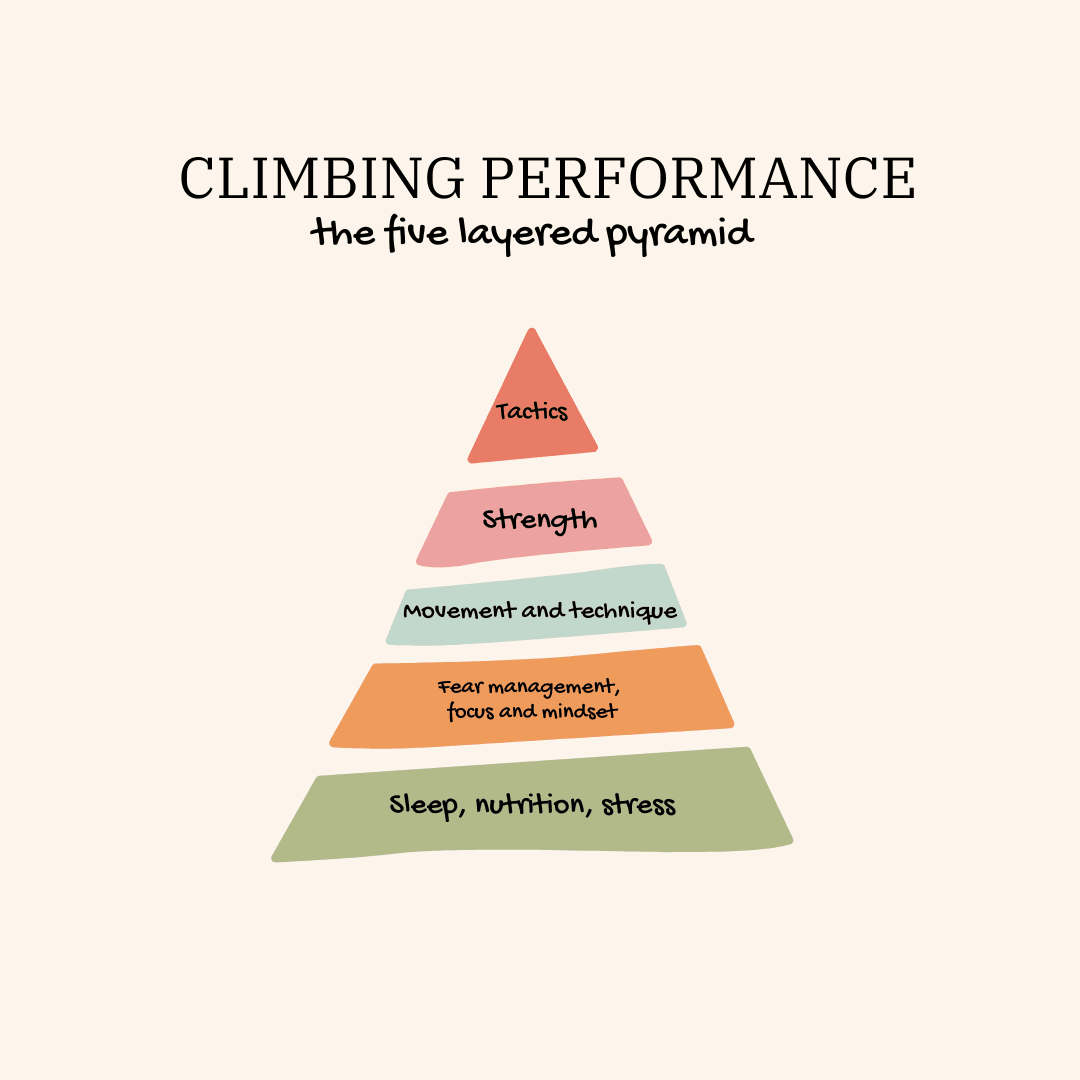
Layer 1: Sleep, Nutrition & Stress
At the base of the pyramid are the fundamentals of health. Adequate sleep, proper nutrition, and effective stress management are non-negotiable. Without them, your body and mind simply cannot perform at their best.
- Sleep improves recovery, sharpens focus and allows physical and mental adaptations to take place;
- Nutrition provides the energy needed for training, climbing and recovery;
- Stress management ensures we recovery well, we have energy and mental capacity for our climbing sessions to try hard;
Neglect this layer, and everything above it becomes harder to achieve.
Layer 2: Fear Management, Focus and Mindset
Next is the mental layer. Climbing is as much about what happens in your head as in your muscles. Fear, hesitation, and lack of focus can sabotage performance more than physical weakness ever could.
- Develop techniques to manage fear and stay calm under pressure.
- Build focus to maintain flow on complex routes.
- Cultivate a growth-oriented mindset to embrace challenges and learn from failures.
This layer ensures that your physical and technical abilities are applied effectively on the wall.
Layer 3: Movement and Technique
Once the foundation is strong, movement and technique take priority. Efficient, precise climbing reduces energy waste, prevents injury, and allows you to tackle more complex routes.
- Footwork, body positioning, and weight distribution are critical;
- Practicing different movement styles builds versatility;
- On top of this, a vital element is cultivating an analytical mindset: actively observing your movements, identifying inefficiencies, and adjusting in real-time.
Layer 4: Strength
I’m going to be bold here: strength sits on top of recovery, mental focus, and movement, not the other way around. You can have all the finger strength, core power, and lock-offs in the world, but if your mindset isn’t solid, fear holds you back, or your movement is inefficient, that strength won’t take you far.
The same principle applies to movement. Sure, you can power through hard moves occasionally, but without the foundation of recovery and mental clarity, raw strength or brute-force movement will only get you so far. Real progress comes when strength amplifies everything beneath it, rather than trying to replace it.
Layer 5: Tactics & Big Picture
At the very top of the pyramid sits tactics—the strategic layer that turns all your preparation into results. This includes route reading, planning sequences, pacing yourself, and knowing exactly when to push or rest.
To break through plateaus, you need to think like a strategist. Tactics mean finding the optimal moment to perform, managing energy efficiently, and reducing constraints that could hold you back. It’s not just about climbing harder—it’s about climbing smarter, using everything from your foundation to your strength in the most effective way.
Why This Hierarchy Matters
The biggest mistake climbers make is training strength first while ignoring recovery, mental skills, and technique. Strength is powerful—but without the right foundation, it won’t make you a better climber and could even lead to injury.
The Climbing Performance Pyramid shows that climbing is a system, not a single trait. Develop all the bases and prioritize the bottom layers first, and performance naturally follows.